



Brazil
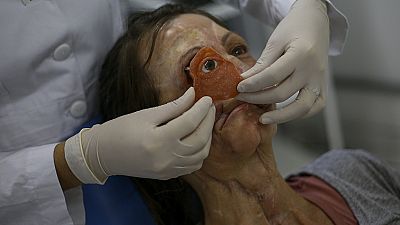
Denise Vicentin is gradually discovering what her new face will look like. This 53-year old Brazilian woman, lost an eye and a large part of her jaw to cancer.
Today, she will look completely different thanks to a prosthesis whose model has been printed in 3D.
In places like bowling, I could feel the look in people’s eyes, and the person would eventually leave the place”, she recounts.
Paulista University researchers are using smartphones and 3D printers to create facial expressions that will serve as models for silicone prostheses. This pioneering method has dramatically lowered costs and cut production times in half.
“By using a mobile phone today, we can do the whole process: using 3D images, we can make a 3D design of the face, print in 3D the prototype we need and transform it into a final prosthesis”, Rodrigo Salazar-Gamarra, lead researcher and maxillofacial prosthodontist said.
It takes about 12 hours to manufacture the prosthesis. This is half of the time required with conventional methods, which also require the use of equipment that can cost up to 450,000 euros.
“We don’t need a big investment to use advanced technology. Because today it is the great revolution of technology, that it has been diversified and democratized for the most needy sectors”, Salazar-Gamarra added.
The prosthesis, the size of an egg, was perfectly fixed to the face, using magnets that adhere to the titanium implants.
Vicentin still has more steps to take, including reconstructing her lips and jaw, but she already feels like a different woman.
“Today I can say how much better I’ll feel on the streets. I have no words”, Vicentin said.
At the moment, there is a waiting list of patients. Researchers hope to be able to treat several dozens of them by 2020.
AFP


00:14
Communities of slave descendants in Brazil demand recognition of territories and livelihood
01:05
Uganda to receive $1.7 billion of US funding under new health deal
02:09
Toxic smoke chokes Conakry community as residents plead for government action
01:00
Tehran's severe pollution forces school closures and limits traffic
02:43
"Tamujuntu": where South Africa and Brazil meet in dance
05:00
How Japan’s food tech innovations target global food security challenges